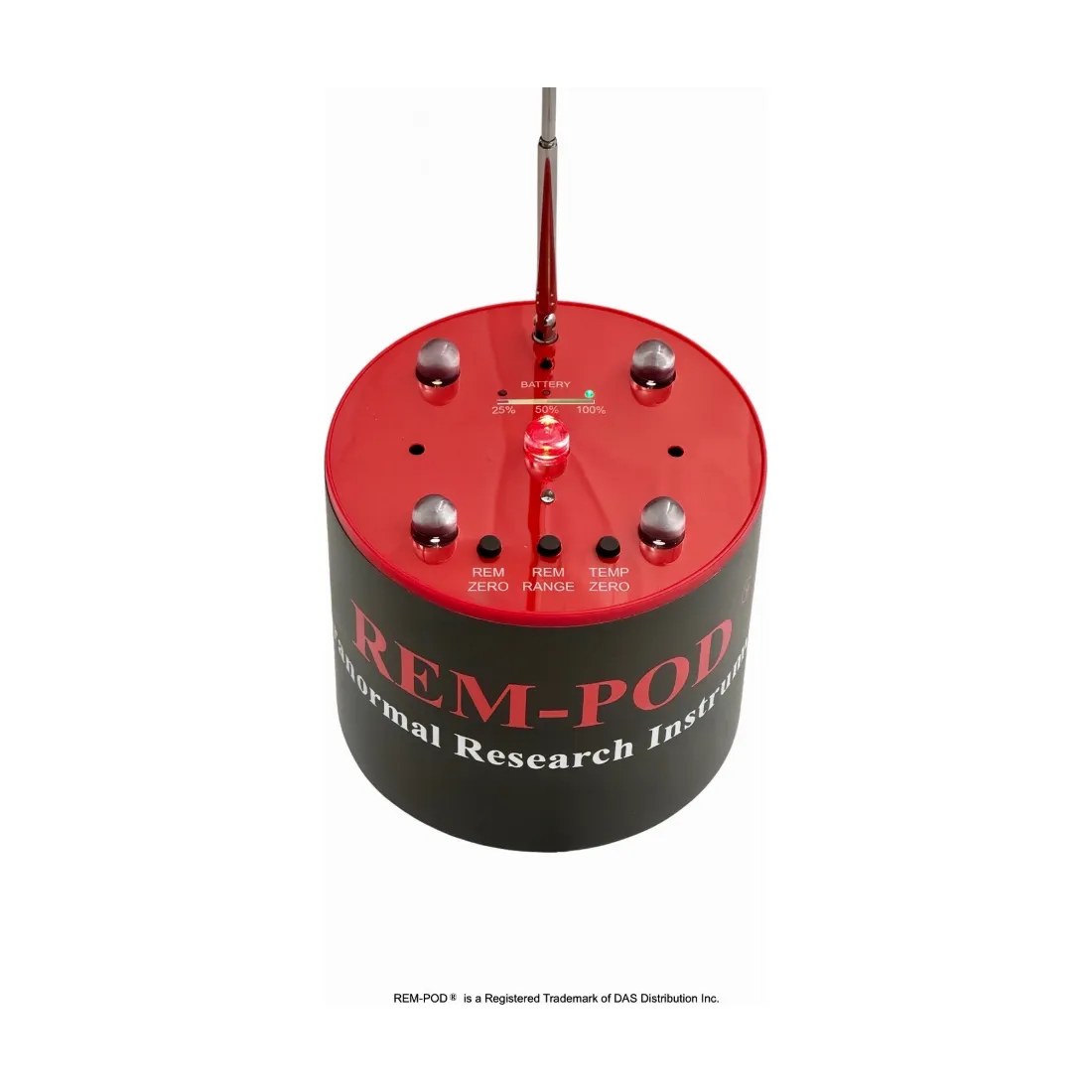
Where to Put a REM-POD: Baselines, Sensitivity, and Placement That Holds Up
A REM-POD is only as good as where you put it. The instrument radiates its own electromagnetic field from a telescopic antenna and responds when something disturbs that field, which means everything near the pod is part of the experiment whether you meant it to be or not. Placement is not an afterthought. It is the technique. Here is how I set one properly.
Start with a clean baseline
The Rev3 offers both manual and automatic baseline calibration. Use one of them, every time, after the pod is sitting in its final position. The baseline is the pod's definition of normal for that exact spot, so calibrating in one place and then moving the unit defeats the purpose. Set it down, let it settle, calibrate, and leave it. If you must reposition mid-session, recalibrate and note the time in your log.
Match the sensitivity to the room
The Rev3 has programmable 5-step sensitivity, and the right setting depends on the building. An electrically busy structure with live wiring and appliances wants a lower step, or you will fight false alerts all night. A quiet rural site can run higher. If the pod is alerting constantly, that is not activity, that is a miscalibrated instrument. Turn it down until it is quiet, and now an alert means something.
My placement rules
- Stable, non-moving surface, or use the integrated tripod mount for repeatable height and position.
- Away from wiring runs, appliances, and metal furniture where you can manage it, and note the distance to anything electronic you cannot move.
- Keep phones and two-way radios away from the pod. They are real radio sources and can trigger a reaction from across a room, and skeptics are right to call that out.
- Write down where the pod is, what is near it, and when you calibrated. An alert without context is noise. An alert with context is data.
Watch: more on the REM-POD Rev3
Reading what it tells you
Once placed, the pod reports two different things and it pays to keep them straight. Field disturbances come through the antenna, with lights and tones, and the high-speed 50 millisecond pulse Field Fringe Detection catches fast, faint disturbances at the outer edge of the field that a slower sensor would miss. Temperature deviation is separate: a rise of 5 degrees gives you a red LED with an ascending tone, and a drop of 5 degrees gives a blue LED with a descending tone, so you know the direction of the change without looking up from your notes. The configurable voice alerts mean you do not even have to be in the room.
Long deployments
The Rev3's lithium-polymer battery is rated around 60 hours, which changes how you can use the instrument. Instead of babysitting it for an evening, set it in a sealed room with a recorder or camera and leave it. An unattended pod in an empty, logged room is one of the cleanest experimental setups in this field: nobody present to trigger it, everything on tape, and a calibrated baseline to measure against.
See the REM-POD (Rev3).


